


The shuttle ride to the Brinkerhoff Family Farm in Parachute, CO, transports us through tree-lined canyons where foliage graduated from vibrant greens to burnished amber, alongside shallow rivers revealing streambeds painted in blue and purple hues—a living testament to Colorful Colorado.
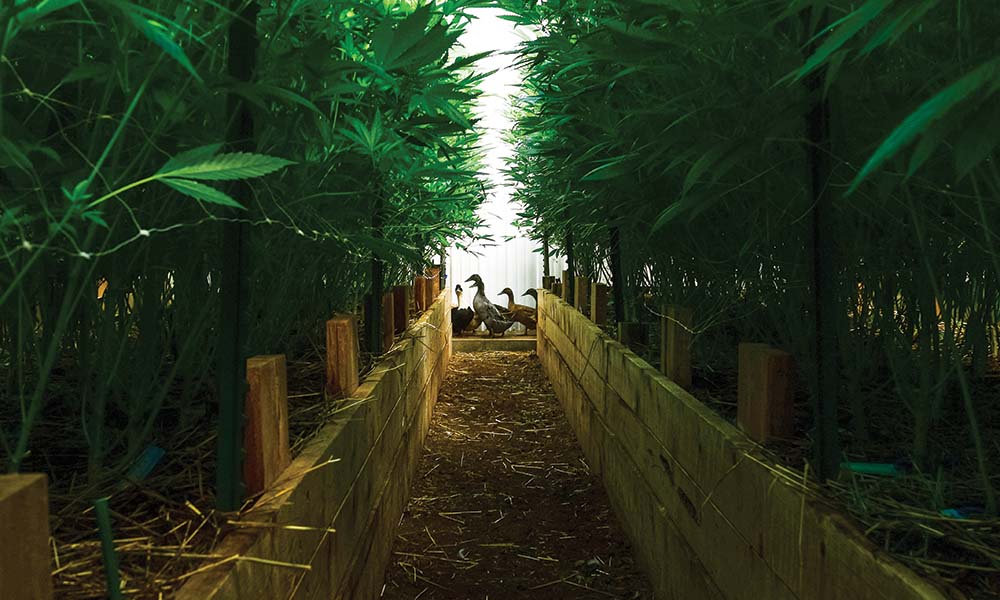
The scenery feels important when thinking about how Edun is different from most of the state’s other cannabis grows. What you see in their cultivation—grass, pepper plants, decomposing leaves, roly poly husks and even ducks—is built from the very land I happen to be riding through. And the wildness and authenticity of their process is present in dancing leaves, hearty stems, crystallized flowers with neon hues and zero visible stress. In a Colorado market littered with shuttered dispensaries and questionable operations, Edun is showing up with a prohibition-era cultivation method that most commercial growers abandoned years ago.
Before entering the grow facility in the small mountain town of Parachute, situated on the Western Slope of the Rocky Mountains approximately 40 miles east of Grand Junction and 200 miles west of Denver, Edun Founder James (Jimmy) Brinkerhoff highlights the wild grasses shimmering with morning dew around the nondescript buildings. “We’re starting a new garden over here where we’re growing rhubarb, which will make fermented plant juice that we feed to our plants every week in a blended tea,” he says.
This isn’t your standard coco-coir-and-bottled-nutrients operation. Edun is a no-till regenerative farm utilizing Korean Natural Farming (KNF), an organic cultivation method that relies on natural inputs and biological functions to create a healthy biome. The approach includes Fermented Plant Juice (FPJ), a fertilizing system common during cannabis prohibition because it was completely untraceable, renewable and provided excellent nutrients and disease resistance. The same fermentation process is used to make kimchi.
At its core, KNF is beneficial because it allows plants to grow and thrive as if in nature. Plants develop better resilience to pests and disease because the habitat is influenced by the same mechanisms as a wild outdoor garden. The soil is rich, nutrient heavy and sustained through processes requiring little intervention. Consequently, no pesticides, fungicides or chemicals are used at Edun.
Brinkerhoff describes the gathering of Indigenous Microorganism (IMO) as he points to the surrounding valley. “We go up a couple thousand feet with these boxes filled with rice and holes in them,” he says. “We put them out for two or three days. The microbes go inside and start multiplying in the rice.” These collected microorganisms are then combined with FPJ and other ingredients in a brew room before being distributed to the facility’s four cultivation rooms, where the real evidence of this system lives.
Walking through the doors, the first thing you notice is what’s missing: no coveralls, no shoe slips, no masks. The air isn’t stale or sterile; instead, it’s light, playful, fragrant. In the mother plant room, the cultivation beds tell a whole story. The first few rows show beds outlined with sturdy wood panels, filled with dirt, leftover roots from previous harvests and grass. Moving toward the back rows with active mother plants, there’s even more: dead leaves, peppers, basil, eggplant, aloe, random organic debris—a whole forest floor ecosystem.
“Peppers are for fun,” Brinkerhoff says. “Basil for my house and some eggplant. The aloe we use for FPJ, we make fermented plant juice out of it. It also can tell you if you have too much or too little water.” He then details how to keep a natural farm thriving: “Moisture is the hardest thing,” he says. “Temperature is easier because you can feel it and it’s one room. Moisture, you have to check every bed.”
While Brinkerhoff provides high-level philosophy, his partner in business and life, Michelle Brinkerhoff, breaks down the technical architecture. Down on one knee, leaning over the wood paneling, she indicates different layers: “Our concept is to follow Mother Nature’s recipe. Mother Earth is like a rock in the middle and then she goes sand, silt, clay, compost.” Michelle dives further into how they’re sourcing locally and sustainably. There’s Colorado River Rock, she says, and the dirt in the beds is six years old and has never been turned over. Michelle credits the natural processes blended with science as the basis for the dirt being so easy to maintain and manage.
The entire building is extremely clean but also very messy, in a natural way. It’s a complex system of controlled chaos. There’s even a family of ducks that wander from room to room and contribute to the ecosystem providing pest and weed control, along with fertilizer, of course. The plants in these rooms exude pungent sweet odors and the leaves wave excitedly as you pass, left alone to bask in the day’s sun and live a full life. While this cultivation provides a vivacious, healthy ecosystem, Edun is not a flower company; rather, they focus solely on extracts and ancillary products that are dominating the market right now.

The exuberance of these plants isn’t just show and tell. While the bud from Edun’s garden isn’t polished and sculpted like many consumers have become accustomed to, there are real results from the KNF practice. Brinkerhoff describes some of the challenges with cannabis. “Our THC might be 22-24 percent, and people are like, we want 30 percent,” he says. “They don’t realize we have really high terpenes. And that’s what it’s all about, that whole mixture of all the terps together.” He says his plants are regularly testing at 4.5-5 percent on terpenes, which is well above industry standards. With high terpenes comes a higher quality and quantity of extracts—a key factor behind Edun’s live rosin-focused product line.
Harvest time brings blissful smells full of heady wafts. But those wafts are volatile compounds exploding at that very moment and they must be cut, shucked and frozen within a very small window of 25-30 minutes. The Edun extraction team operates in 40°F rooms during the washing and pressing of the product as an additional protocol to preserve as many terpenes as possible. The modern extraction blended with the natural garden is creating some of the more consistent and reliable extracts on the market today.
Just down the road from Edun is a Tumbleweed Dispensary, a mountain chain that opened in 2016. With an eviction notice on its door, now it’s just another casualty in Colorado’s cannabis market graveyard. This is the context in which Edun operates. While legacy operations get locked out of their own buildings, the Brinkerhoffs are building something fundamentally different. Their original vision was to house independent growers and train them in KNF methodology. “When we started, I was going to build these buildings and lease them to cultivators, different ones around Colorado,” Brinkerhoff says. They wanted to teach young growers the benefits of using the KNF method and how it’s symbiotic with the natural surroundings.

When the market started dropping, Brinkerhoff saw no choice and became his own tenant, he says. But in a race-to-bottom market where operators are cutting every corner to survive, Edun is now building soil—literally and figuratively—that’ll outlast the current industry shake-out. Their method isn’t just about growing cannabis differently; it’s about creating a regenerative system that improves over time rather than depleting resources.
Edun’s chaotic forest floors and companion-planted beds blended with science and data represent something rare going into 2026 Colorado cannabis: actual modernization rooted in cannabis prohibition wisdom.
Premium Live Rosin
Even on a chilly morning, when my nose isn’t operating at full capacity, I could pull a gram of Edun’s rosin from the fridge and still get a strong whiff of the terpenes. While most of Edun’s product line is focused on extracts, they do carry 0.5g live rosin infused dog walker joints in 2 and 5 packs.
All-In-One (AIO) Live Rosin Mini Vape Cart
The All-In-One (AIO) vape is discreet, dialed in for easy use and provides a clean smoke throughout its entire life.
510 Thread Live Rosin Vapes
Significantly larger in size than the AIO, these vapes offer a wider variety for a more personalized experience.
This story was originally published in issue 52 of the print edition of Cannabis Now.
The post Edun: Bringing Craft Back To Cannabis appeared first on Cannabis Now.