


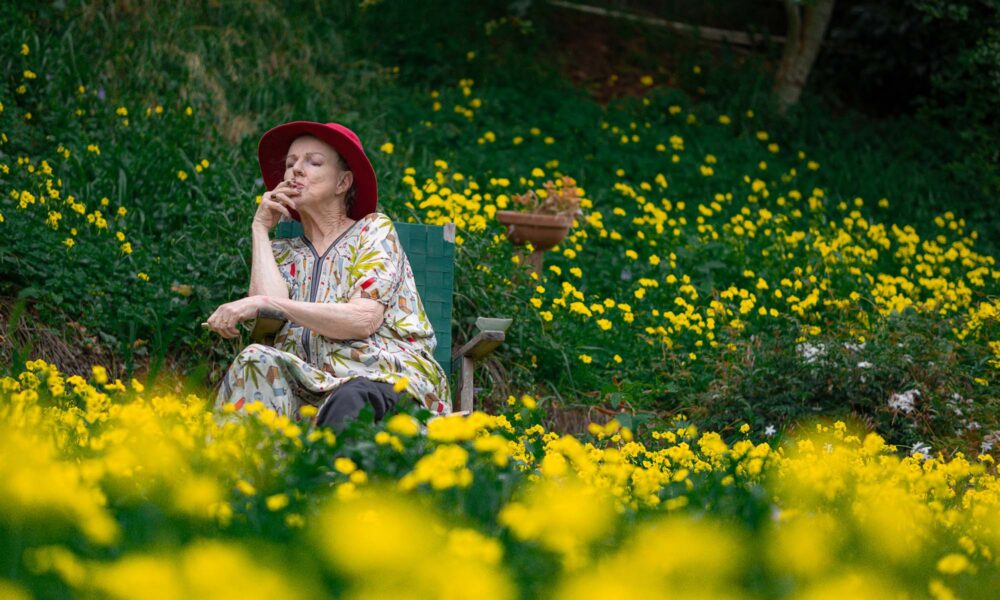
Speaking with Shelley Johnson—known to her millions of followers as “A Good Witch”—feels like affirmation cards come to life, only less polished and far more entertaining.
“Being a whole person is not about judgment. Being a whole person is about accepting yourself.”
“You are divine and you are connected. Nothing on this earth can shake you.”
“What you think about me is none of my business.”
These are just a few of her mantras.
It’s only a few minutes into our Zoom call—how Johnson holds all her virtual tarot card readings—and I already feel better, calmer. At 73, Johnson has mastered something most people spend their lives chasing: the ability to be fully present.
But Johnson didn’t start becoming a “Good Witch” at 69, when her Instagram persona took off @agoodwitchofficial. For more than three decades, she worked as an occupational therapist, building her own practice in the 1970s—uncommon for a woman at the time—and helping patients who believed their lives were limited rediscover what was possible. Her methods weren’t always conventional. She used humor, blunt honesty and even tarot cards to better understand how to connect with the people she was treating.
“I’ve always asked the same question,” she says. “How do I get you to relax, enjoy, learn and grow?”
That question still drives everything she does today—it’s just packaged differently.
Scroll through Johnson’s social media, and you’ll find a mix of offbeat humor, cannabis content and hard-earned life advice. One moment she’s joking about smoking weed and sharing bong-cleaning tips; the next, she’s reminding viewers to love themselves exactly as they are—then baring her chest post-mastectomy, urging them to release shame around their bodies. It’s chaotic, a little disarming—and intentional. Cannabis, in particular, has helped her invite people in.
“I give you what you want, so you’ll listen to what I have to say,” she says, adding that her cannabis humor is meant to help people shed any shame around what she sees as a normal, regulatory medicine.
Johnson has been open about her relationship with the plant—starting young, getting sober for nearly two decades, then returning to it after a breast cancer diagnosis made pharmaceutical treatments unbearable. “I started smoking again at 50, quit the pharmaceuticals and stopped going crazy,” she says. “I’m not an insane bitch when I smoke pot.”
But she’s quick to clarify: Cannabis isn’t a cure.
“The cure-all is regulating the nervous system,” she says. “Pot doesn’t fix it—it helps it.”
This nervous system work’s something Johnson explored deeply after her cancer diagnosis in 2000. She stepped away from occupational therapy and went back to school for studio arts, where she discovered that sculpture—working with her hands, being fully present in the moment—would become a key part of her healing. “I sculpt because I have to—for neuro-regulation,” she says. “I need time where I’m not thinking, where I’m not worried about the future or worried about the past.”
She found this to be especially true after developing trigeminal neuralgia as a side effect of chemotherapy, which caused chronic facial pain for years. What ultimately helped wasn’t medication, but shifting her focus. “When I stop paying attention to my body, the pain diminishes,” she says. “That’s why I have to sculpt.”
Johnson uses cannabis as a tool, just like sculpture. A puff before a workout. Before a walk. Before painting or sculpting. Not to escape, but to slow down enough to engage.
“If I get too stoned, I miss me,” she says. In her view, the real issue isn’t what people use—it’s why they’re using it. That’s why she sticks to low-THC, balanced products—often outdoor, organic flower from Moon Made Farms. Getting too high, she says, defeats the purpose entirely. The goal isn’t to check out—it’s to stay present.
“People aren’t checking out from reality,” she says. “They’re checking out from themselves.”
It’s a perspective shaped not just by personal experience, but by decades of working with others. Long before she was building an audience online, Johnson had already developed another unconventional tool: tarot. She’s been reading cards for more than half a century, beginning shortly after graduating college, when she found herself unsure how to emotionally connect with her first patient.
So, she bought a deck of tarot cards. At night, while charting, she’d pull cards and use them to better understand how to approach each patient. “I always interpret the cards in a way people can learn and grow,” she says. “Not in a way that shows limitations.”

In other words, the same work she was doing as a therapist—helping people reframe their experiences, regulate their reactions and move forward—just through a different lens.
That throughline’s what makes Johnson’s current persona feel less like reinvention and more like evolution. The “Good Witch” was born out of necessity during the pandemic, when Johnson could no longer sell her artwork in person and needed to drive traffic online. A consultant suggested she sell herself, not just her art.
“Who could you be?” he asked.
“Well, I’m a witch,” she replied.
To Johnson, the label wasn’t about aesthetics or mysticism. It was about agency.
“Why am I a witch? Because I can create whatever I want,” she says. It’s the same belief system she’s carried for decades: that people aren’t limited by circumstance, only by the way they think about it. “I’m not restricted to other people’s ideas,” she says. “I create the reality of my living.”
That mindset has carried her through a life that includes being kicked out of multiple churches, building a career on her own terms, surviving cancer, raising two daughters and continuously reinventing how she expresses herself—whether through therapy, art or now, social media.
It’s also what resonates with the millions of people who follow her.
Johnson’s content isn’t polished or aspirational in the traditional sense. It’s raw, sometimes chaotic, often funny and occasionally blunt to the point of discomfort. But underneath it there’s a consistent message: Relax. Pay attention. Learn. Grow.
In an online landscape crowded with curated wellness advice and perfectly packaged self-help, Johnson’s approach stands out precisely because it isn’t trying to be anything other than what it is. She’s not positioning herself as a guru. She’s not claiming to have all the answers. If anything, she’s doing what she’s always done—meeting people where they are, getting their attention however she can and then nudging them toward something better.
You can call it therapy. You can call it spirituality. You can call it content.
She calls it being a good witch. So do we.