


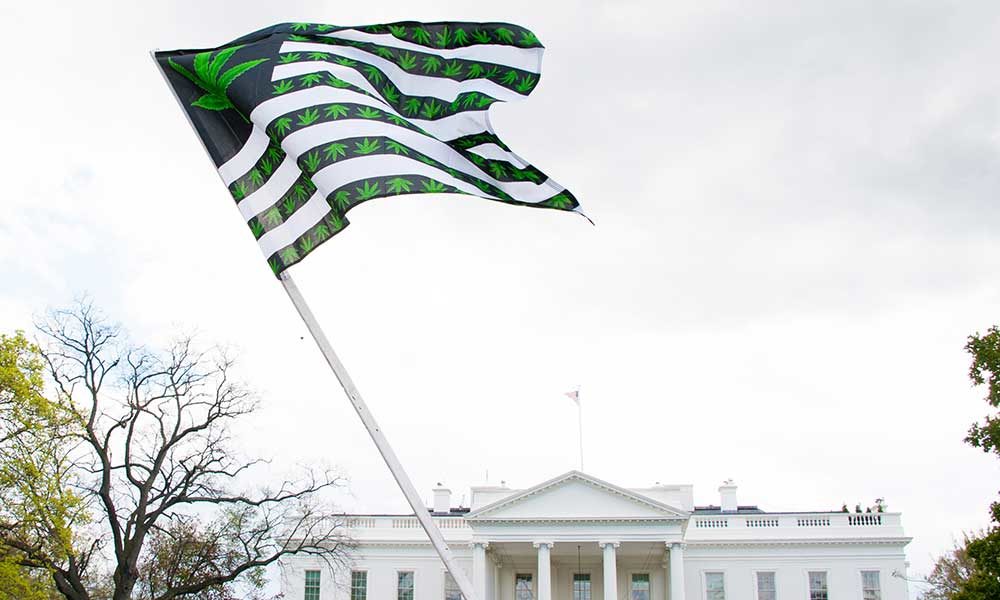
The federal government on Thursday officially reclassified regulated medical marijuana from Schedule I to Schedule III under the Controlled Substances Act, marking the most significant shift in U.S. cannabis policy in more than 50 years.
The order, first reported by Associated Press, was signed under the Trump administration earlier today after months of accelerated pressure inside the Department of Justice. It immediately changes how cannabis is defined under federal law—formally acknowledging its accepted medical use for the first time since 1970, though it stops short of full federal legalization.
“Today’s rescheduling of cannabis marks a historic turning point for the industry and a long-overdue modernization of federal policy,” said Darren Lampert, Chief Executive Officer of GrowGeneration Corp., a retailer focused on hydroponics, cultivation equipment, nutrients, lighting systems and infrastructure used by both commercial growers and serious home cultivators. “It recognizes the legitimate medical value of cannabis, supports expanded scientific research, and removes barriers that have constrained responsible businesses and patient access for years.”
Lampert added that the shift could have immediate ripple effects across the broader cannabis economy.
“This decision creates a stronger foundation for investment, innovation and job creation across the supply chain,” he said. “For companies like GrowGeneration, which support cultivators and operators nationwide, greater regulatory clarity will help accelerate growth and efficiency throughout the market.”
For the first time since 1970, Washington is no longer officially maintaining that licensed medical cannabis has no accepted medical value. That matters because, for more than 50 years, the federal government placed marijuana in the same category as heroin, despite nearly 40 states building medical programs, millions of patients legally using cannabis, and years of scientific evidence pointing toward therapeutic value.
The DEA order, obtained exclusively by Cannabis Now from the White House, formally acknowledges what much of the country has already accepted: Cannabis is no longer being defined by federal law in the same way it was during the height of prohibition.
“This is a meaningful step forward—and a long overdue acknowledgment of reality,” said National Hemp Association Chairman Geoff Whaling. “While this action does not directly impact hemp—already removed from the Controlled Substances Act under the Agriculture Improvement Act of 2018—it is another significant step in normalizing the broader cannabis category. And that matters.”
A Long Road to Recognition
For the cannabis community, today carries emotional weight beyond policy.
For decades, activists marched, patients testified, families fought for access, and entire communities built legal cannabis markets while people were still being arrested under a framework that insisted marijuana had no medical legitimacy. Today’s announcement does not erase that history—but it changes the federal tone in a way that many believed would take much longer.
It also immediately raises a deeper justice question: What happens to the thousands of people still incarcerated, or still carrying criminal records, for conduct tied to a plant the federal government now partially recognizes as medically valid?
“This is the most significant drug policy change in this country in 50 years,” said Daniel Cook, CEO of True Terpenes. “It legitimizes medical marijuana programs in 40 states, expands legitimate research, and delivers 280E relief to state-licensed medical operators, who have been carrying effective tax rates as high as 70%.”
Cook added that while the shift is meaningful, it stops short of where the industry ultimately needs to land.“ Cannabis shouldn’t be Schedule III—it belongs in a single-plant regulatory framework alongside hemp. But this is a meaningful step, and the industry should take the win.”
Schedule III does not automatically free prisoners, vacate prior convictions, or trigger nationwide clemency. Federal criminal penalties tied to non-licensed cannabis activity remain in place. But politically and culturally, the contradiction becomes harder to ignore. If cannabis now holds accepted medical standing, pressure will only increase around sentencing reform, pardons, expungement, and broader social equity demands.
Even with the change, the broader inconsistencies remain unresolved. “Cannabis doesn’t belong on any schedule. Period,” said Jason Harris, renowned glass artist and founder of Jerome Baker Designs. “The federal government is now acknowledging medical use, while the broader plant and the culture surrounding it remain in a legal gray area. That disconnect is still very real.”
Immediate Financial Impact
For legal operators, the financial effect is immediate because companies may now gain relief from IRS Code 280E, the federal tax rule that has long punished cannabis businesses by blocking ordinary deductions. That rule has been one of the biggest hidden burdens in legal cannabis, often forcing profitable companies into impossible tax structures.
“Reclassification will allow cannabis businesses to be treated more like traditional businesses from a tax perspective, helping to create a more sustainable and equitable operating environment,” said Kevin Pattah, CEO of Mango Cannabis.
Public markets reacted within hours.
Among the strongest movers was GrowGeneration (GRWG), one of the sector’s best-known ancillary cannabis companies. Unlike plant-touching operators, GrowGeneration sits in a strategic lane because it supports cultivation without directly selling cannabis itself.
Today, the stock surged sharply, climbing from an opening level near $1.44 to an intraday high around $1.57, a jump of roughly 18–19% at peak trading, with volume accelerating well above recent daily averages. That kind of move reflects investor belief that if cannabis operators suddenly become healthier financially, cultivation infrastructure companies like GrowGeneration may benefit quickly as operators resume expansion, upgrades and facility investment.
At the same time, several major U.S. cannabis operators moved higher:
- Curaleaf surged as investors priced in possible margin improvement under reduced tax pressure.
- Trulieve Cannabis also gained sharply, reflecting renewed optimism around multi-state operators with strong medical exposure.
- Green Thumb Industries moved higher as traders rotated into companies with strong retail and medical market footprints.
What Comes Next
Those gains matter, but the deeper story remains cultural: Cannabis is again proving that policy follows culture, even if slowly.
For years cannabis has existed in two Americas at once—openly sold, taxed, prescribed and normalized in one part of the country, while still burdened federally by language rooted in another era. Today narrows that divide.
Research is also expected to expand. Universities, hospitals, biotech firms and medical institutions should now face fewer barriers when studying cannabinoids, dosing systems, and long-term therapeutic use. That could lead to stronger clinical legitimacy, broader insurance discussions, and eventually more sophisticated cannabinoid medicine.
Still, this is not full legalization.
Adult-use cannabis remains federally illegal. Interstate commerce is still blocked. Banking reform remains unresolved. State-by-state fragmentation remains intact.
That fragmentation may evolve next.
“The DEA hearings to review overall rescheduling start on June 29, and that process could take a long time,” said Dave Marrow of Lume Cannabis in Michigan. “This only applies to state-licensed medical sales, while the majority of licensed cannabis sales in the U.S. are adult-use.”
Marrow added that regulatory structures may begin to converge at the state level: “I think states with adult-use programs will evolve their licenses to include medical sales under the same framework,” he said.
But after half a century of federal resistance, one thing is now unmistakable: The United States government has officially stepped away from saying cannabis has no accepted medical place in American life.
And for an industry built by people who often moved long before federal permission arrived, that moment carries real meaning today.