


When cannabis was legalized in Canada, the industry was given very few tools to educate the public. One of the only things permitted on packaging (as a consumer safety requirement, not an educational tool) was the total THC percentage. THC is one of the main psychoactive compounds in cannabis, notable for its ability to contribute to the feeling of being “high.” With nothing else to reference, this number quickly became the only thing anyone talked about, and over time, it was misused as a proxy for quality.

Today, higher THC almost always equals higher demand. But here’s the truth: That single number doesn’t tell the whole story. Not even close.

Quality is shaped by so much more than total THC content, including terpene profile, flower density, trim quality, and moisture. These are qualities you can see, smell, and feel, not just read on a label. Although not mandatory, at Village Farms Canadian Cannabis, we include terpene percentages on many of our dried flower SKUs, because we know it provides important context. It’s like wine. You wouldn’t judge a bottle by its alcohol content alone. You’d want to know the grape, the region, the flavour. Cannabis deserves the same level of consideration.
At Village Farms Canadian Cannabis, we’ve spent years growing cannabis at scale. We’ve seen how much the plant can vary, from harvest to harvest, strain to strain, even within a single plant. So, we decided to put it to the test.
Our team of in-house scientists recently conducted one of the most in-depth studies on potency variability in commercial cannabis ever published. The results appeared this month in Scientific Reports, part of the Nature Portfolio. The study analyzed multiple strains and batches, sampling flower from the top, middle, and bottom of plants.

What they found was clear: THC levels aren’t consistent. The top and middle consistently showed higher potency potential, within the same plant and between batches.
This matters because cannabis products in Canada are labelled with a single THC number. In many cases, that number may reflect just one sample from one section of one plant. It’s not representative of the batch, the full bag, and it certainly doesn’t tell you what your experience will be. The current system is misleading, and as more Canadians turn to cannabis for a range of needs, they deserve more accurate, meaningful information.
That’s why we believe THC should be labelled as a range, not a fixed percentage.
At Village Farms Canadian Cannabis, we already calculate these ranges using real data from thousands of batches. And let me tell you, they are predictable and measurable. The science is clear. Ranges offer a more realistic view of what consumers can expect. This gives us a strong foundation for smarter regulations, better consumer education, and a more honest conversation about what quality really means.
If we want an industry that’s mature, transparent, and built on trust, we must be able to better explain what consumers are getting and our labelling must reflect the full picture of the product. It’s time to shift the conversation from chasing potency to truly understanding quality.
Our understanding of the plant is evolving. Our labels should too.
The full study, titled “Variability of Total THC in Greenhouse Cultivated Dried Cannabis” is now publicly available through Scientific Reports, part of the Nature Portfolio of journals.
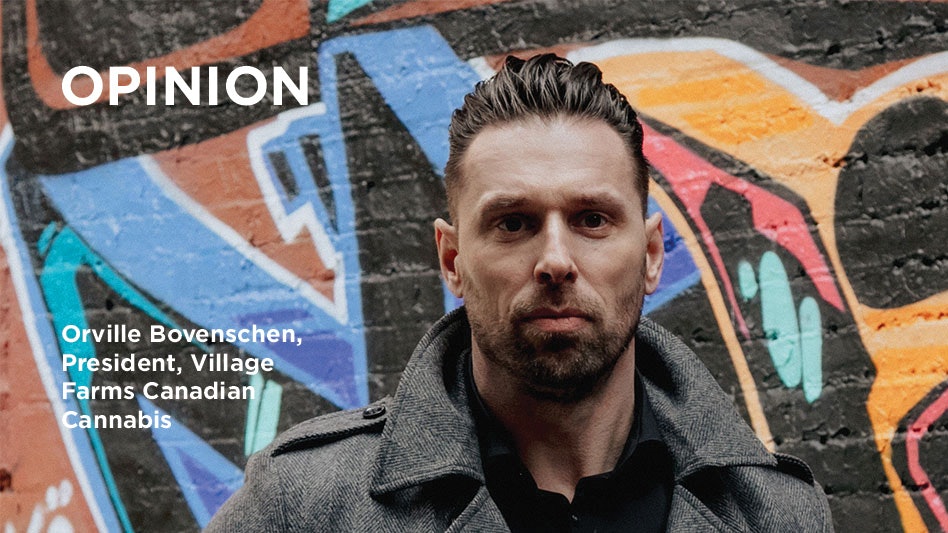
Orville Bovenschen is the president of Village Farms Canadian Cannabis, overseeing Pure Sunfarms and Rose LifeScience. With a background in global operations and strategic leadership, he is driving innovation and growth across one of Canada’s leading emerging sectors.